The Malmquist index was first suggested by Malmquist (1953) as a quantity for use in the analysis of consumption of inputs. Fare (1994) developed a DEA-based Malmquist productivity index which measures productivity change over time. The index can be decomposed into two components, with one measuring the change in the technology frontier and the other the change in technical efficiency. To describe the method, let  denote the input and output levels for a DMUj at any given point in time t. The Malmquist index calculation requires two single period and two mixed period measures. The two single period measures can be obtained by using the CRS DEA model. Thus, for period t we solve following CRS DEA model which calculates the efficiency in time period t, as:
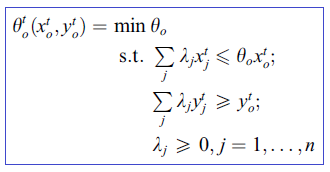
In a similar way, using t + 1 instead of t for the above model, we get the technical efficiency score for DMUo in time period t + 1. The first of the mixed period measures which is defined as  for each DMUo, is computed as the optimal value to the following linear programming problem:
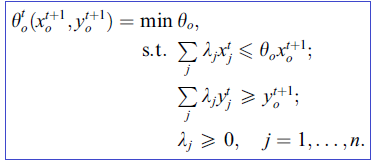
This model compares  to the frontier at time t. In a similar way, we can obtain the other mixed period measure,
 which compares
  to the frontier at time t + 1. The (input-oriented) Malmquist productivity index can be expressed as:
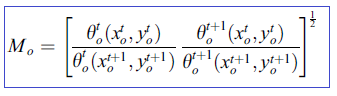
Mo measures the productivity change between periods t and t + 1. Productivity declines if Mo > 1, remains unchanged if Mo = 1 and improves if Mo < 1. The following modification of Mo makes it possible to measure the change of technical efficiency, and the movement of the frontier in terms of a specific DMUo.
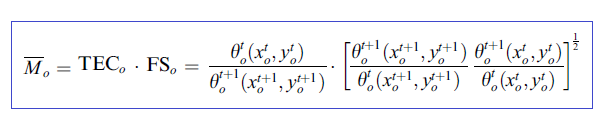
The first term on the right hand side measures the magnitude of technical efficiency change between periods t and t+1. The second term FSo measures the shift in the frontier between periods t and t + 1. A value of FSo greater than unity indicates regress in the frontier technology, a value of FSo less than unity indicates progress in the frontier technology, and a value of FSo equal to unity indicates no shift in the frontier technology.